
Corner balancing on a budget chassis
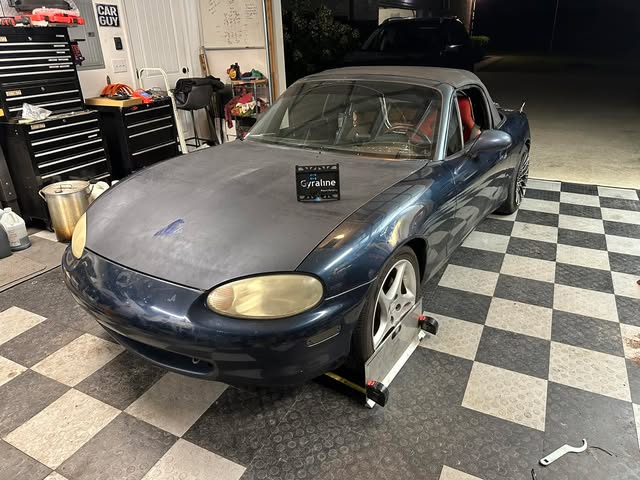
Corner balancing gets talked about as something that only applies to built race cars. It doesn't. It applies to anything you drive with intention — a street car you push on back roads, a track car that came with someone else's coilover setup, a budget build you put together yourself and want to actually handle the way you intended.
The principle is simple. The detail that makes it useful is one thing most people leave out: your weight in the seat while you set it.
What corner balancing actually does
A corner balance puts the car on four scales simultaneously and measures the load on each contact patch. The goal is to distribute that load so the car handles consistently — left corner to right corner, front axle to rear axle — under the conditions it's actually going to see.
Cross-weight percentage is the key number. It is calculated from two diagonal pairs of wheels — front-left plus rear-right divided by total weight. 50% is neutral. A number significantly above or below that means the car is going to handle differently through left-hand and right-hand corners, and no damper setting will completely fix that.
Why driver weight changes everything
Ride height determines corner weight distribution. But ride height with an empty car and ride height with a 175-pound driver sitting in the seat are not the same — especially on a lightweight chassis where the driver is a significant fraction of the total weight.
We have seen corner weights shift by eight to twelve percent cross-weight when the driver sits down. A car that looks balanced on an empty scale can have a significant bias once you account for where the driver sits, which on most Japanese sport compacts and older German chassis is forward and to the left of center.
The correct procedure is to set corner weights with the driver seated at correct fuel load. Without that, you are optimizing for a condition the car will never actually be in.
What this costs on a budget chassis
The setup process takes roughly two to three hours. You adjust the spring collars on your coilovers until the scale reads where you want it, check the alignment after because height changes affect geometry, and verify the final numbers at driver weight.
On a budget chassis — a first-generation MX-5, an E36, an S13 — the limiting factor is usually coilover thread engagement and spring rate. If your springs are too stiff to compress enough to make meaningful adjustments, or the collars are at the end of their travel, corner balancing will tell you that too. It's useful diagnostic information regardless of whether you can fully dial the car in on the first visit.
What you take home
A setup sheet with every number: corner weights, cross-weight percentage, ride heights at the standard measurement points, and alignment figures at the end of the session. That sheet is the baseline for the next event.
When something changes — a new spring rate, a different tire compound, a corner you added — you come back with the sheet and adjust from a known starting point rather than starting over. That compounding effect is the real value of doing it correctly the first time.
It's an afternoon. The car comes out feeling like someone thought about it. That is usually enough to make someone a believer.